One mile southeast of Richmond town centre, on the eastern bank of the River Swale, stand the ruins of Easby Abbey. Founded in 1152 by Roald, Constable of Richmond Castle, this Premonstratensian monastery offers one of the most complete surviving examples of a White Canons' house in England, whilst its adjacent parish church conceals rare 13th-century wall paintings that reward the short riverside walk from Richmond.
The White Canons of Richmond
Easby Abbey, properly the Abbey of St Agatha, was established in 1152 as the third Premonstratensian house in England. The order, founded by St Norbert at Prémontré in France, took its colloquial name from the white habit worn by its canons. Unlike monks bound to their cloisters, Premonstratensian canons engaged in preaching and pastoral work throughout the surrounding countryside, following an austere code similar to that of the Cistercians but with a public ministry that brought them into daily contact with Richmond townspeople.
The abbey was a daughter house of Newsham Abbey in Lincolnshire, and its strategic location beside the Swale placed it within easy reach of Richmond Castle whilst maintaining the seclusion required by the order's rule. The canons raised sheep and operated a mill on the river; the dam still runs through part of the ruins today, a testament to the water management that sustained monastic life here for nearly four centuries.
Patronage and Burials of the Scrope Family
The Scrope family of Bolton Castle were long-standing patrons of Easby Abbey, and the abbey's choir served as their burial place for generations. According to testimony given by John, Abbot of St Agatha, in the Scrope v. Grosvenor case of 1385-1390, Scrope family tombs were located east of the quire, near the high altar. Those buried at Easby included Henry le Scrope, William le Scrope, Richard le Scrope (1st Baron Scrope of Bolton, d. 1403), and successive barons Roger, Richard, Henry, and John Scrope.
This aristocratic patronage brought wealth and influence to the abbey, though it could not protect the community from the violence of the Border wars. In 1346, the abbey suffered considerable damage when an English army was billeted there en route to the Battle of Neville's Cross. Scottish raids throughout the medieval period caused further destruction, forcing the canons to rebuild repeatedly.
Dissolution and After
The Suppression came in 1536. Within two years, most of the abbey buildings had been stripped and demolished. The manor was granted to John, Lord Scrope of Bolton, in 1537, and remained in Scrope hands until 1726, when it was sold to Bartholomew Burton.
Despite the destruction, significant architectural remains survived. Excavations conducted in 1886 by the Yorkshire Archaeological and Topographical Association revealed an unusual trapezoidal cloister, an irregularity caused by the proximity of the parish church. The gatehouse, with its lower stage dating from the foundation period and upper stage from circa 1290, still displays round-headed arches with nailhead ornament. The magnificent refectory, the gatehouse, and the canons' dormitory remain amongst the most complete Premonstratensian ruins in England.
The abbey's architecture attracted artists from the Romantic period onward. J.M.W. Turner was amongst those who found inspiration in the ruins, contributing to Easby's reputation as one of the most picturesque monastic sites in the North of England.
The Wall Paintings of St Agatha's Church
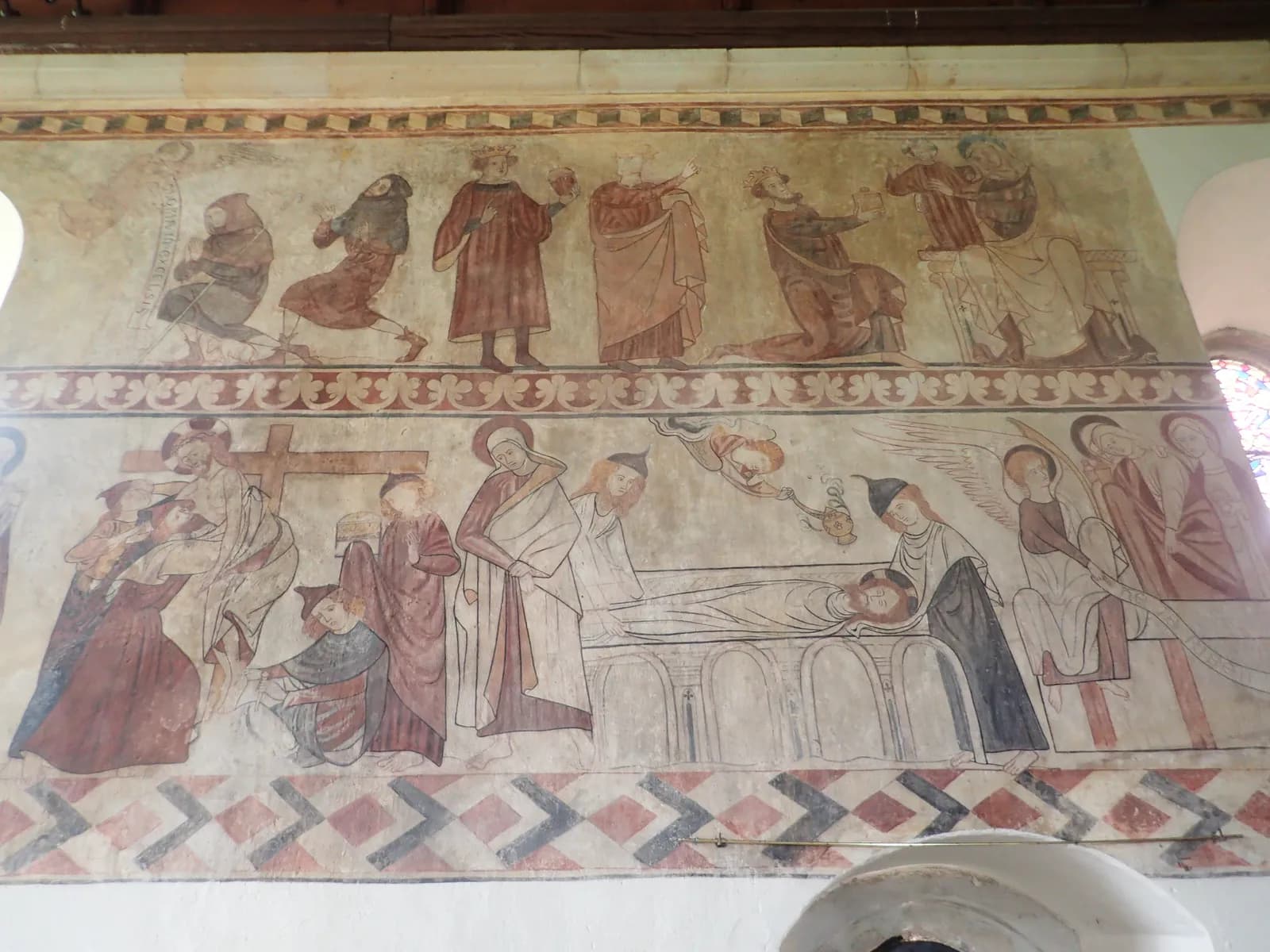
The true artistic treasure of Easby lies not in the ruined abbey but in the adjacent parish church of St Agatha, which predates the monastery and remains an active place of worship. Built circa 1150s, the church conceals a remarkable cycle of 13th-century wall paintings that were rediscovered during restoration work by George Gilbert Scott in 1869.
The north wall of the nave depicts scenes from the Garden of Eden, showing characters sowing, digging, pruning, and hawking. The south wall carries scenes from the Nativity and Passion of Jesus. These paintings, restored by Burlinson and Grylls, offer a rare glimpse into the devotional art of the 13th century and the biblical education provided to medieval parishioners.
The church also contains two pieces of 12th-century stained glass in the east window, depicting Saint John and a Premonstratensian canon. A plaster replica of the Easby Cross, an Anglo-Saxon cross dating from 800-820 AD, stands in the church; the original, recovered from the church walls in 1931, now resides in the Victoria and Albert Museum.
Richmond's Monastic Heritage Today
Easby Abbey is now a Grade I listed building, privately owned but maintained by English Heritage. Entry is free, and the site is open daily from 10am to 6pm (end March to October) and 10am to 4pm in winter. The car park is situated off the B6271, with a £1-2 donation requested for St Agatha's Church.
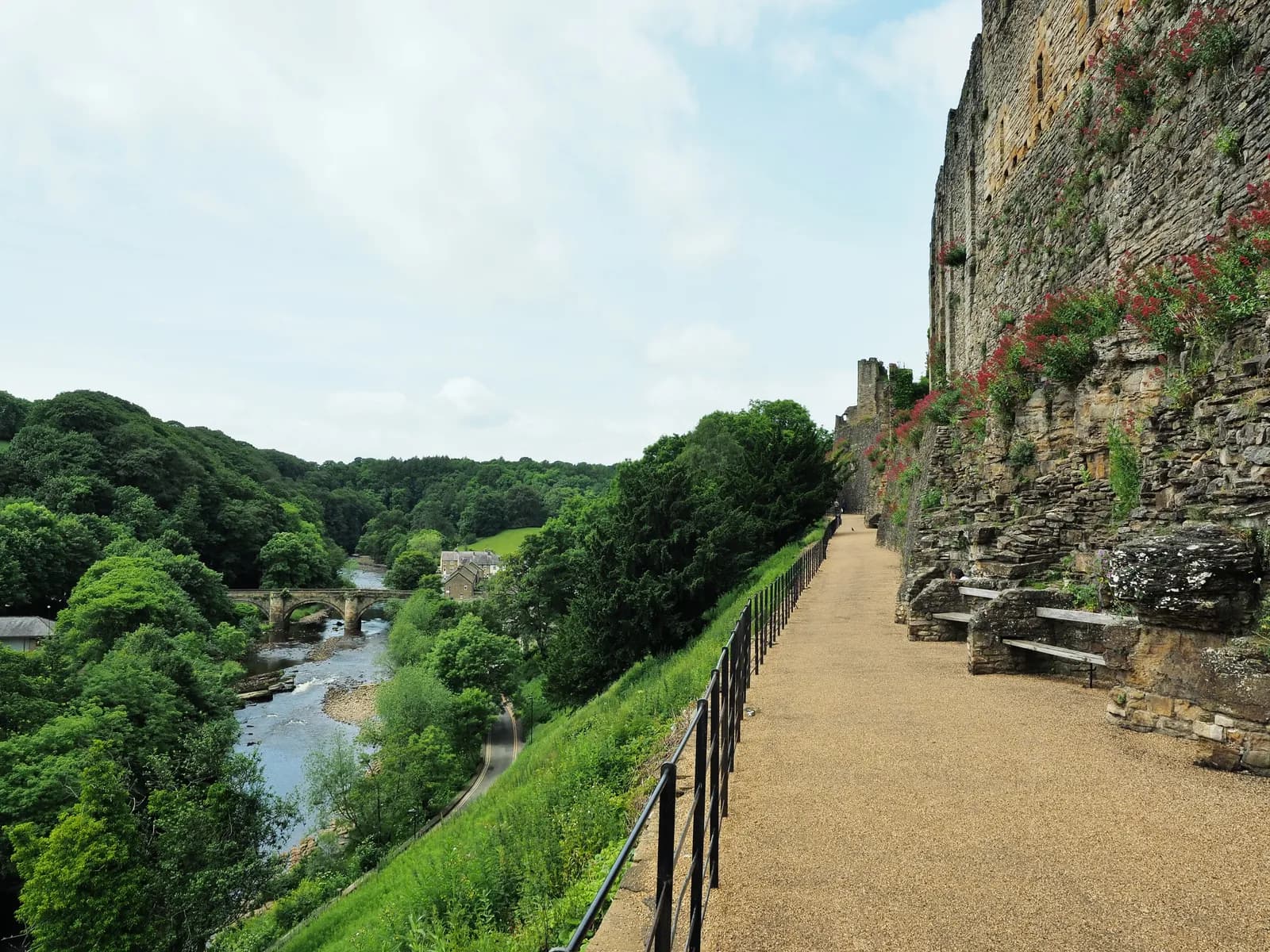
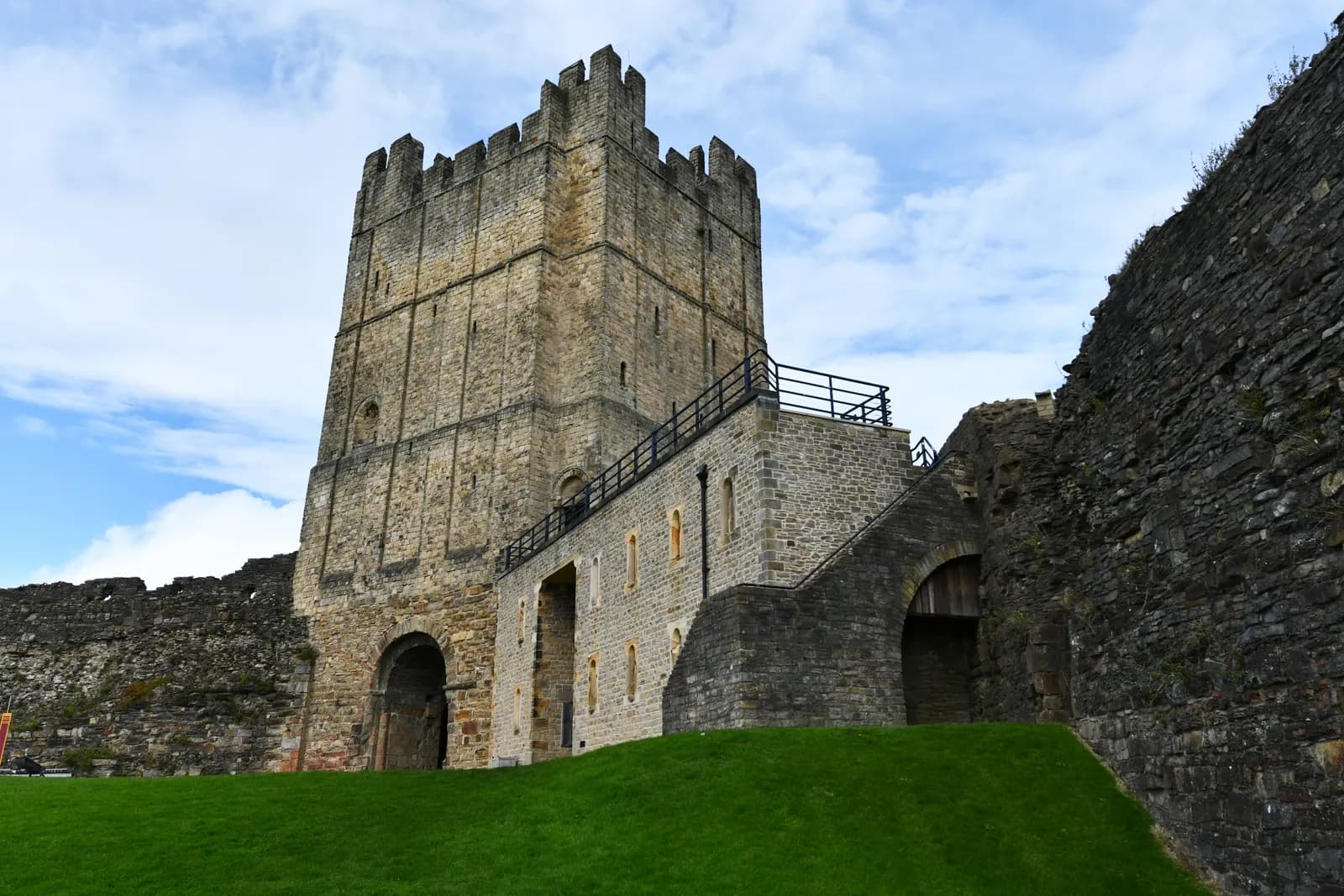
The abbey's connection to Richmond remains tangible. The riverside walk from Easby Abbey to Richmond Castle takes approximately 35 minutes, following a path that medieval canons and townspeople would have known well. Richmond Castle, managed by English Heritage, offers facilities including a shop, toilets, and a picnic area overlooking the River Swale.
Dogs on leads are welcome at the abbey ruins. Guided tours can be arranged between November and March by contacting gillian.sulley@english-heritage.org.uk. St Agatha's Church continues as part of the parish of Easby, Skeeby, Brompton-on-Swale, and Bolton-on-Swale in the Richmond Deanery of the Anglican Diocese of Leeds.
The ruins, the wall paintings, and the riverside setting combine to make Easby one of the most significant heritage sites within walking distance of Richmond town centre. The abbey stands as a reminder of the monastic power that once surrounded the castle, and of the continuous religious life that has marked this stretch of the Swale for more than eight centuries.