The Last Keeper of an Ancient Recipe
By the early 1980s, Swaledale cheese was all but extinct. For centuries, farming families in the Yorkshire Dales had produced this distinctive cheese, but industrialisation and changing tastes had reduced production to a single smallholding. By 1980, only Mr and Mrs Longstaff of Harkerside, above Reeth in Swaledale, were still making it the traditional way. When Mr Longstaff died shortly afterwards, his widow sold the smallholding and retired from cheese making. The recipe that had been handed down through generations of her family, shrouded in mystery, faced permanent disappearance.
The 1987 Revival
In November 1986, Mrs Longstaff entrusted that precious recipe to David and Mandy Reed at Harkerside farm. She became their chief taster, guiding them as they worked to re-establish authentic Swaledale cheese using methods that had not changed in centuries. In February 1987, the Reeds formally founded The Swaledale Cheese Company, and a local tradition that had nearly vanished was brought back to life.
The company established itself in Richmond, grounding the revival in the historic market town at the gateway to Swaledale. Today, the business operates from Metcalfe Farms at Leyburn, approximately eight miles from Richmond, continuing to produce cheese in the heart of the dale that gives it its name.
Tracing the Monastic Origins
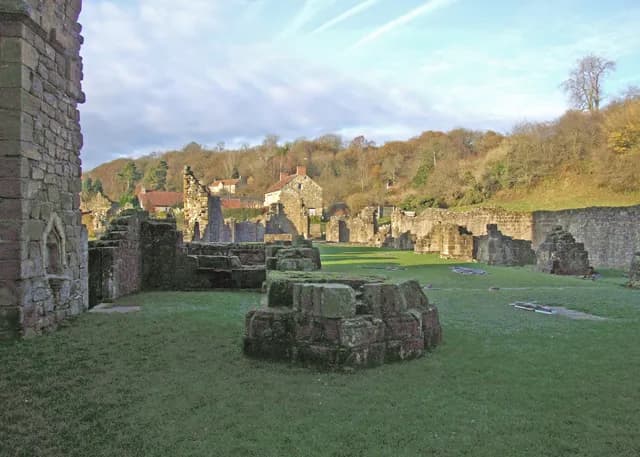
Legend holds that cheese making first came to the Yorkshire Dales in the 11th century, brought by Christian monks from Normandy who settled in local abbeys. These Cistercian monks established major foundations across the region, including Rievaulx Abbey near Helmsley, founded in 1132 by twelve monks from Clairvaux Abbey, and Fountains Abbey near Ripon, which became one of the wealthiest monasteries in England. Both were significant sheep farmers and wool producers; Fountains Abbey supported 140 monks and 500 lay brothers at its peak.
The recipe that Mrs Longstaff preserved, passed down through generations of her family, may trace its lineage to these medieval monasteries. The Cistercian order, which expanded into Britain from 1128 onwards, brought agricultural expertise and cheesemaking knowledge from continental Europe. Whether the Swaledale method originated directly from the monks or developed independently among local farmers remains unconfirmed, but the connection represents a living link to nearly a thousand years of Dales history.
Protected Designation and Production
The Swaledale Cheese Company achieved Protected Designation of Origin (PDO) status for both Swaledale Cheese and Swaledale Ewes Cheese in 1995. This legal protection, updated in 2008 to meet European Union and DEFRA requirements, prevents imitation products from using the Swaledale name. To qualify, cheese must be produced within the Swaledale area using traditional methods that reflect the region's unique heritage, recipe, character, and reputation.
Production grew steadily after the 1987 revival. By 2007, the company was producing approximately 1.75 tonnes per week, roughly 91 tonnes annually. More recent figures indicate production of around 70 tonnes per year. The company now produces varieties made from cow's milk, ewe's milk, and goat's milk, including smoked and organic options.
The cheese has earned recognition beyond Yorkshire. In 2008, The Swaledale Cheese Company won three gold awards at the Great Taste Awards and three gold medals plus two bronze medals at the World Cheese Awards.
Family Continuity Through Tragedy
The business faced a profound challenge on 20 July 2005, when David Reed died unexpectedly of a heart attack. The family demonstrated resilience; his daughter Louise Reed had joined the business in June 2005, and his son Sam Reed followed in May 2007. Mandy Reed continued as Managing Director, ensuring the company survived this difficult period and maintained the tradition her husband had worked to revive.
Richmond's Living Heritage
The story of Swaledale cheese is now inseparable from Richmond. The town serves as the commercial and cultural centre for the cheese's production and marketing, even as the company has moved to larger premises nearby. The PDO status ensures that cheese bearing the Swaledale name reflects the specific terroir of the dale: the herbs, grasses, soil, and climate that contribute to its distinctive character.
What began as a medieval tradition, preserved through generations by farming families, nearly disappeared entirely in the 1980s. That it survives today, available in shops and restaurants across the region, owes entirely to Mrs Longstaff's decision to entrust her family's recipe to the Reeds in 1986, and to the subsequent work of a Richmond-based company that recognised the value of this heritage.
For Richmond residents, Swaledale cheese represents more than a local product. It is a tangible connection to the monks who settled here nearly nine centuries ago, to the farming families who kept their knowledge alive through the centuries, and to the 1987 revival that prevented this chapter of local history from closing forever.