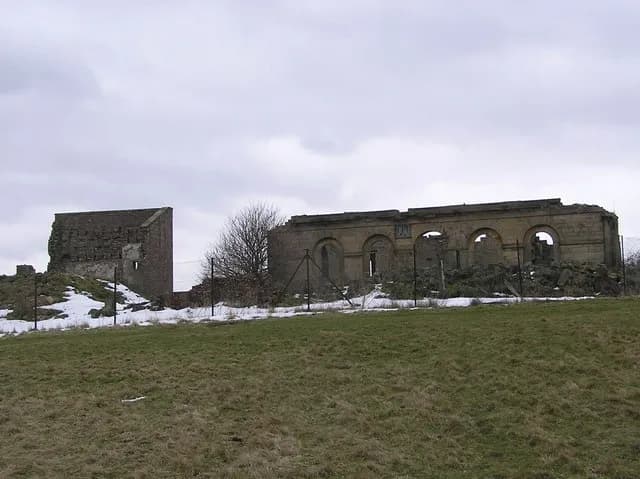
The stone grandstand at Richmond Racecourse, erected in 1775, holds the distinction of being the oldest surviving stone-built public grandstand in the world. Yet this Grade II* listed structure, designed by the eminent architect John Carr, now sits on Historic England's Heritage at Risk register, its future uncertain after decades of decline.
A Georgian Sporting Landmark
Richmond's racing history stretches back centuries. The first documented races on the town's High Moor occurred in 1576, with a hiatus during the 1740s when George II imposed a minimum £50 prize requirement designed to exclude lower classes from participation. Racing resumed in 1760, and by 1765 the venue had shifted to Low Moor, where a permanent course was established at an elevation of 847 feet.
The impetus for a grandstand came from the Hambleton Hundred Guineas Race, a prestigious fixture that drew competitors from across the country. Between 1765 and 1775, a temporary wooden structure served spectators each September. Public subscription funded the construction of a permanent stone replacement in 1775, with John Carr, then the leading architect in northern England, commissioned to design it.
Carr's Richmond grandstand represents a rare survival of his sporting architecture. He also designed grandstands at York, Doncaster, and Nottingham, all of which have since been demolished. His other works include Harewood House and Buxton Crescent, cementing his status as one of the North's most influential Georgian architects.
The Rise and Fall of Richmond Racing
The racecourse flourished throughout the late eighteenth and nineteenth centuries. The September meeting became a major social occasion in Richmond, accompanied by militia musters, assemblies, and theatre performances. Richmond shared the Hambleton Gold Cup with York on an alternate basis, attracting the country's finest thoroughbreds.
The course measured roughly 1.5 miles in circumference, with races run clockwise. However, its oval configuration presented challenges; one turn proved too tight for the increasingly powerful thoroughbreds being developed through selective breeding. In August 1891, the final race meeting took place.
The Jockey Club determined that nearby Catterick, which opened in 1783 and enjoyed better road and railway connections, offered a more suitable venue for modern racing. Richmond's relative isolation from main transport routes contributed to its decline.
Decades of Neglect
Following closure, the grandstand suffered a slow decline. The lead roof was stripped in the 1950s, exposing the interior to the elements. Further demolition occurred in the late 1960s, leaving the structure in its current ruined state.
The architectural features that remain hint at its former grandeur. The ground floor originally featured five round-headed arches with a Tuscan arcade. Above stood a balcony with railings, an upper storey with round-headed windows, and a flat roof capped by a balustraded parapet. A separate private stand, built in 1814 for the Zetland family, has not survived.
Heritage at Risk
Historic England added the grandstand to its Heritage at Risk register in 2019, citing its poor condition. The structure faces significant restoration challenges; a 2001 report referenced projected costs of £1.25 million, a substantial sum for a building that no longer serves an active sporting purpose.
The site itself remains active. Horse trainers continue to use the gallops for exercising thoroughbreds, and public footpaths crisscross the former course, which is now designated as Open Access Land. The open grassland provides views across the surrounding North Yorkshire countryside, preserving some of the atmosphere that drew spectators in the Georgian era.